Wednesday January 2nd
San Francisco, CA
approx 11 pm
clear skies
2hrs
looking due north
I think that i was able to identify the other constellations. I believe the ones that i am looking at are gemini and taurus. I was also able to see the moon in its waning crescent phase.
Wednesday, January 9, 2008

observation 2.3
Tuesday January 1st
San Francisco, CA
approx 11 pm
clear skies
2hrs
looking due north
Over the break, I visited San Francisco. As i was sitting on the back porch i was able to identify some of the stars in the sky. I could see the three stars that formed Orion's belt in the Orion constellation. I saw several other shapes that i think were constellations but i am not sure what they were. I will have to look them up.
San Francisco, CA
approx 11 pm
clear skies
2hrs
looking due north
Over the break, I visited San Francisco. As i was sitting on the back porch i was able to identify some of the stars in the sky. I could see the three stars that formed Orion's belt in the Orion constellation. I saw several other shapes that i think were constellations but i am not sure what they were. I will have to look them up.
Monday, January 7, 2008
Biography 2
William Rutter Dawes
 William Rutter Dawes was a British astronomer who was born in 1799. As a young man, Dawes trained at St. Bartholomew's Hospital in London to become a physician. In 1826, he moved to Liverpool, where he took up an interest in Astronomy. He then became heavily influenced by Rev. Thomas Waffles, which resulted in Dawes taking charge of a small congregation in Ormskirk. In 1929, he returned to his astronomical studies and began to investigate binary stars. Through his studies, Dawes was able to improve upon Sir John Herschel's observations on double stars by refining his 3.8 inch Dolland refractor telescope. Therefore, he was able to collect more accurate data about binaries. He was often nicknamed "eagle eye." Due to bad health and his wife's death, in 1839 Dawes gave up his congregation and moved to London. There he became an assistant to George Bishop in his private observatory. Bishop allowed Dawes to use this observatory, which included a 7 inch refractor telescope, until 1844. He then moved to Kent and was able to build his own personal observatory with 6.5 inch Merz refractor. With this telescope, Dawes helped to discover Saturn's crepe ring. In 1855, he won the gold medal of the Royal Astronomical Society and in 1864 he made detailed drawings of Mars during its opposition. These drawings helped Richard Anthony Proctor make a map of Mars in 1867. Because of his work concerning Mars, craters on both Mars and the Moon are named after Dawes, as well as the optical phenomenon called the Dawes limit. In 1865 he was named a Fellow of the Royal Society and died just a short 4 years later in Haddenham.
Dawes crater on Mars

Drawings of Mars
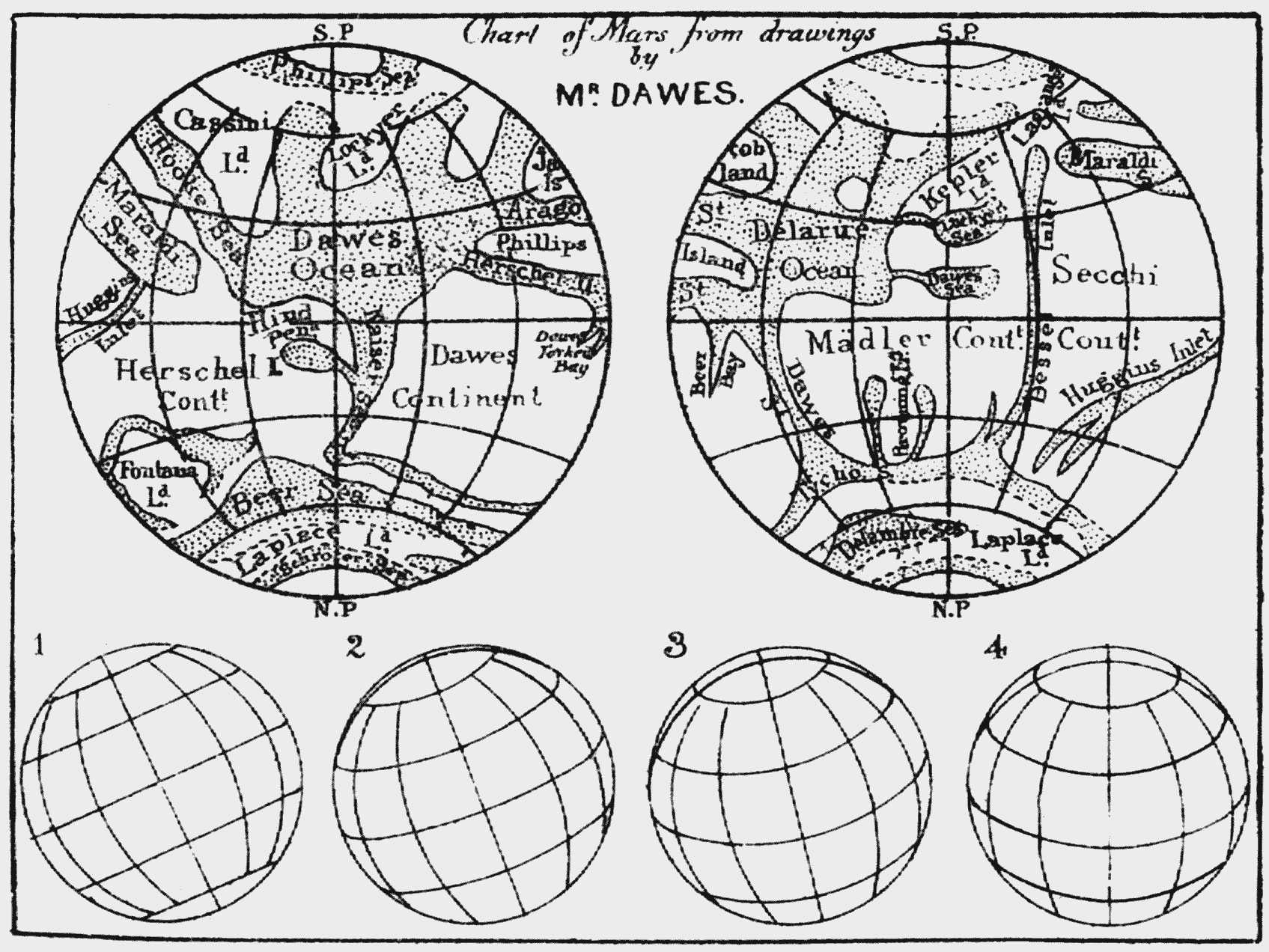
larger picture)
Bibliography
http://www.mikeoates.org/astro-history/dawes.htm
http://en.wikipedia.org/wiki/William_Rutter_Dawes
http://www.britannica.com/eb/question-152951/49/William-Rutter-Dawes-born
http://www.spiritus-temporis.com/william-rutter-dawes/
http://www.colorpro.com/wmdawes/images/dawes-crater-on-mars.gif
http://www.gutenberg.org/files/16767/16767-h/16767-h.htm
Friday, December 14, 2007
observation 2.2
Thursday, December 13th
approx. 11:15 pm
Clear skies
looking east
2 hrs
As i was sitting in my back yard last night studying, i saw what you explained to us today is mars. My backyard faces east, so i was able to look straight ahead and see it. It looked like a small reddish-orange dot in the sky. It was relatively bright and i was able to focus my eyes on it without too much strain. it was interesting to see something in the sky that is not just a bright white light and actually has some color!
Note: i just wanted to remind you that my apods and observations are not numbered correctly and you told me just to leave them and not worry about it. Just so that you count all the ones i have. thanks!
approx. 11:15 pm
Clear skies
looking east
2 hrs
As i was sitting in my back yard last night studying, i saw what you explained to us today is mars. My backyard faces east, so i was able to look straight ahead and see it. It looked like a small reddish-orange dot in the sky. It was relatively bright and i was able to focus my eyes on it without too much strain. it was interesting to see something in the sky that is not just a bright white light and actually has some color!
Note: i just wanted to remind you that my apods and observations are not numbered correctly and you told me just to leave them and not worry about it. Just so that you count all the ones i have. thanks!
apod 2.4
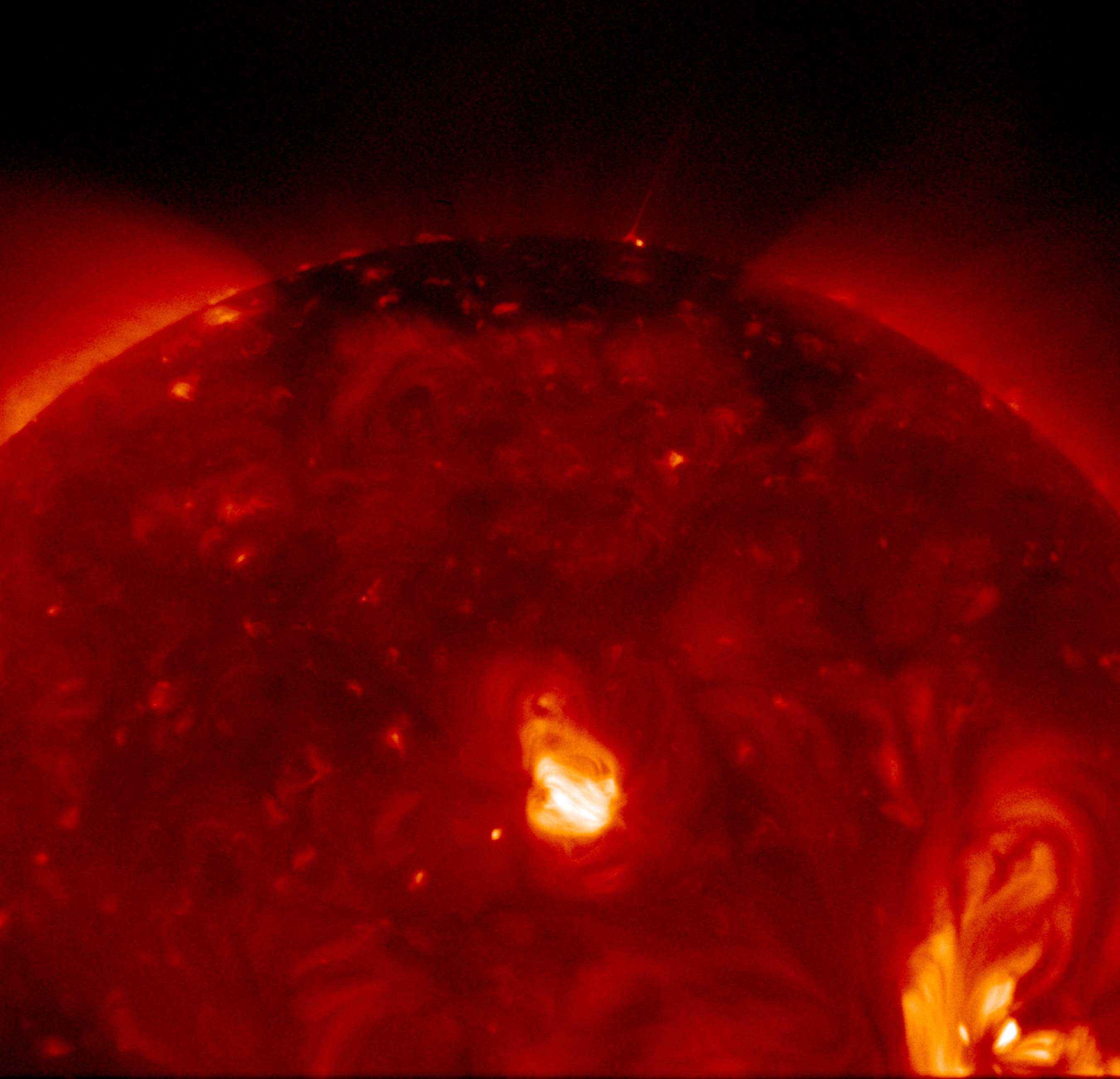
this is a picture of the jets and waves that are emitted from the sun. I think it is amazing that there is so much activity on one single planet and that space probes are able to take photographs of this activity. The description said that the jets and waves are created by magnetic reconnection events. Even though space travel is probably my greatest fear, i think it would be very cool to be able to see the sun from a closer distance and see some of the energtic activity on the sun from that close.
Friday, December 7, 2007
observation 2.1
Friday, December 7th
approx 7:10 am
clear skies, early morning, just getting light
30 mins
This morning, as i was driving to school, I saw a small light about 15 degrees above the moon. Apparently, this light was the planet Venus. The moon also looked very cool. it was a tiny crescent and almost could not be seen. I looked it up online and it said that the new moon should be occuring on December 9th.
approx 7:10 am
clear skies, early morning, just getting light
30 mins
This morning, as i was driving to school, I saw a small light about 15 degrees above the moon. Apparently, this light was the planet Venus. The moon also looked very cool. it was a tiny crescent and almost could not be seen. I looked it up online and it said that the new moon should be occuring on December 9th.
apod 2.3
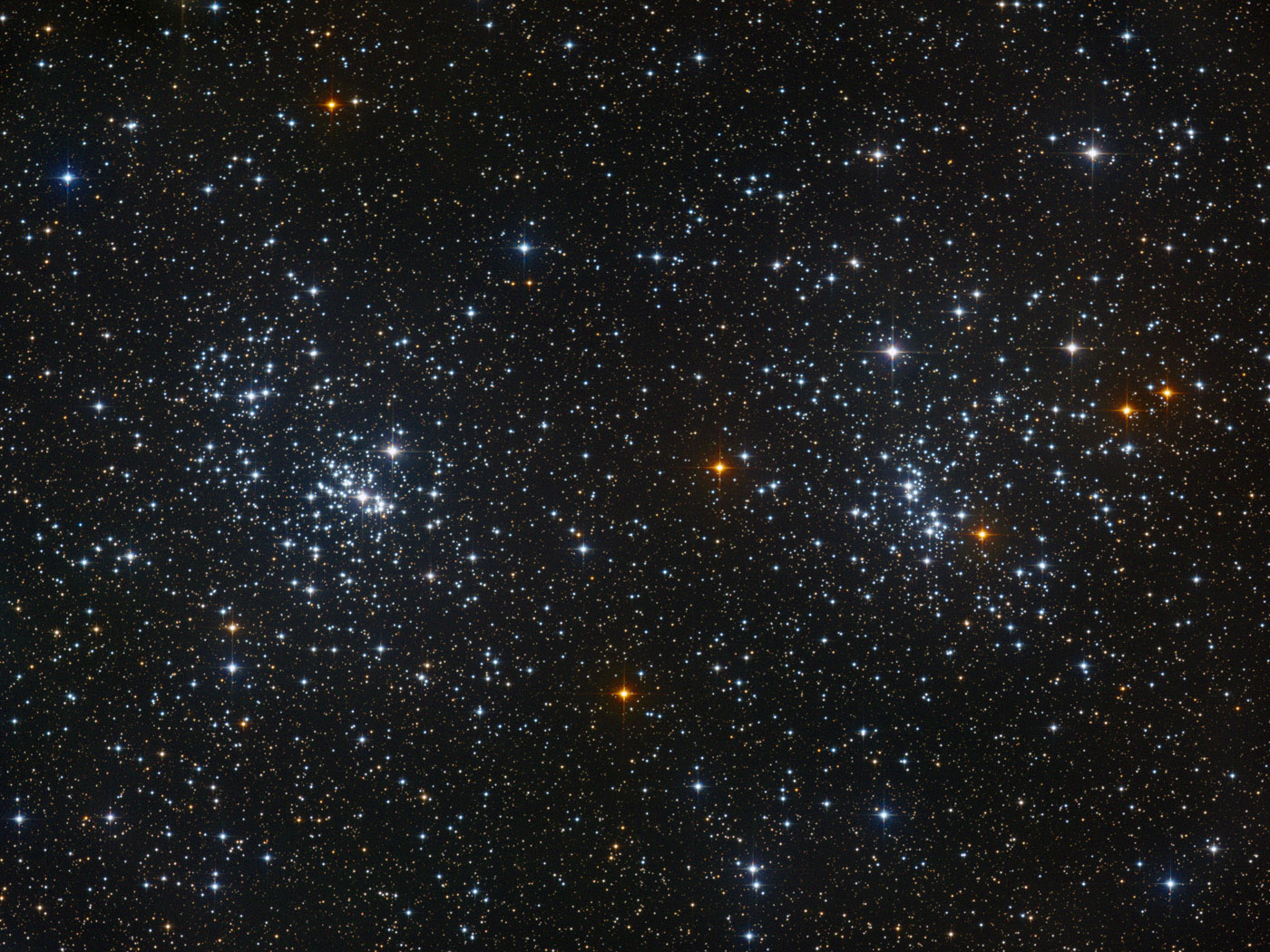
This is a picture of the double cluster in the constellation Perseus. Since we had this constellation this week and learned that there was a double cluster in it, it was interesting to see what it actually looks like. it is also cool to know that this is the only double cluster that has been found in the universe. I found it strange how in the picture the 2 clusters look relatively close to each other, yet in the description it said that they are actually several light years away from each other!
Subscribe to:
Posts (Atom)